1390 stories
·
0 followers

FCC accused of hiding Chairman Carr's messages with DOGE and Musk

1 Share

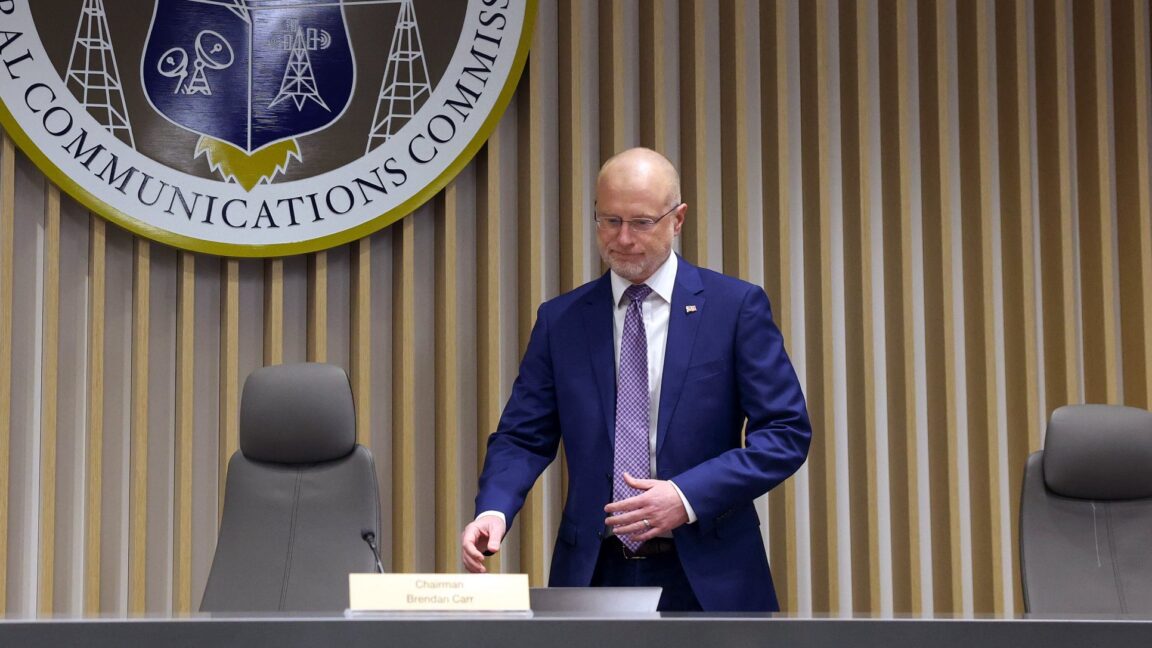
An advocacy group trying to investigate DOGE's influence on the Federal Communications Commission accused the FCC of failing to comply with a public records request and of concealing Chairman Brendan Carr's use of the Signal messaging service.

"The evidence clearly demonstrates that the FCC has acted in bad faith by withholding documents responsive to Plaintiffs’ FOIA [Freedom of Information Act] request," journalist Nina Burleigh and advocacy group Frequency Forward said in a filing yesterday in US District Court for the District of Columbia. "The FCC acted in bad faith when it redefined the search criteria without notice to Plaintiffs or this Court. Further, the FCC acted in bad faith by concealing the fact that the Chairman Carr has a Signal account on a phone he uses to conduct government business."

Burleigh and Frequency Forward sued the FCC last year, alleging that it violated the Freedom of Information Act by wrongfully withholding agency records. In August 2025, a federal judge ordered the FCC to produce documents and criticized it for a “vague and uninformative” response to the lawsuit.

The plaintiffs filed the initial FoIA request in February 2025 for an investigation into how DOGE's activities at the FCC may have created conflicts of interest related to Elon Musk's SpaceX and Starlink, which are seeking various FCC licenses and authorizations.

"The evidence strongly suggests that Musk bought his way into the White House and to obtain his position as the de-facto head of DOGE, and that he had used his government authority and access to information to earn huge profits for himself and his companies," plaintiffs said yesterday. "Plaintiffs’ FoIA request seeks documents that shed light on the relationship between the FCC, Musk as regulator and Musk and his companies as regulated entities."

Burleigh and Frequency Forward asked the court to deny an FCC motion for summary judgment, order the agency to produce all responsive documents within a week, and allow the plaintiffs to file discovery requests. Their filing accused the FCC of having "wasted a year of the Court’s time and frustrated Plaintiffs’ efforts to timely review critical records."

The FCC "has sought to delay the production of responsive documents and obfuscate the existence of responsive records," and "made it clear that it will not undertake a good faith effort to produce responsive documents," the filing said. "Accordingly, discovery is required and will speed the document production process by helping the Plaintiffs identify responsive documents."

Carr's phone

The filing said there is evidence that Carr has Signal messaging set up on a phone he uses for FCC business. Carr's phone number was previously disclosed in a FoIA request that turned up a November 2024 email from a Fox News producer who was confirming an interview. Entering that "number into the Signal app shows that he has an active Signal account under the username 'Brendan Carr,'" the filing said.

A court filing submitted by the FCC on June 3 said that Carr did not have phone numbers for DOGE personnel and that "it is agency policy not to download additional messaging applications on FCC phones (e.g., Signal, WhatsApp)." Plaintiffs counter that Carr likely exchanged messages with Musk or other high-ranking DOGE officials.

"Plaintiffs do not know whether the number identified in Exs. 4 and 5 belongs to Carr’s personal phone or a government issued phone," the filing said. "What we do know is that a phone is being used for government business and that it has a Signal account in Carr’s name. Based on information and belief Carr regularly conducts government business through text and Signal messages, communicating with journalists, industry professional and individuals who work for regulated entities, such as Musk and SpaceX."

Plaintiffs said the FCC's statement that Carr did not have phone numbers for DOGE personnel doesn't settle the matter.

"It is unlikely that Carr would have communicated with individuals at that level. Carr would have communicated with Musk or other highly placed DOGE officials," the filing said. Plaintiffs said a previous case involving DOGE showed that "DOGE personnel routinely conducted business on their personal phones using text messages, especially the Signal app."

The filing separately accused the FCC of limiting its records search to emails with FCC, DOGE, and GSA (General Services Administration) domains, despite plaintiffs' objections. It also said that travel documents provided by the FCC did not include anything about Carr's visits to Starlink facilities.

We contacted the FCC today and will update this article if it provides any comment.
Read full article

Comments


Read the whole story
Share this story
Delete

Renewable Energy Just Hit 30% of America's Electricity Generation

1 Share
America generated 10.06% more energy with renewables in the first four months of 2026 than it did in the same period the year before. That's according to new figures from America's Energy Information Administration, cited in this report from Electrek: The growth was led by utility-scale solar (+21.3%), hydropower (+15.7%), small-scale solar In April alone, wind and solar each produced more electricity than US coal plants, while the combination of solar and wind produced 57.0% more electricity than nuclear power. The mix of all renewables, including biomass and geothermal, accounted for 30.0% of total US electrical generation during the first third of 2026 — up from 27.8% a year earlier... EIA reported that, in April, utility-scale solar capacity surpassed wind capacity for the first time (160,208.1 MW vs. 160,100.6 MW). Further, utility-scale battery energy storage capacity increased by 17,703.5 MW, or 58.1%. Nuclear added just 18.4 MW. The combined capacity growth of all utility-scale renewable energy sources for the 12-month period (55,980.3 MW) is two-thirds more (i.e., 67.6%) than that added during the previous 12 months (33,392.0 MW). "EIA projects no new nuclear generating capacity and a net decline of 5,200.5 MW in fossil fuel capacity."

Read more of this story at Slashdot.

Read the whole story
Share this story
Delete

Non-Invasive Stimulation of the Brain Ended Opioid Addiction, Cigarette Craving

1 Share
The Jerusalem Post reports that doctors at Haifa's Rambam Health Care Campus "have successfully treated their first Israeli opioid addiction patient using an experimental noninvasive brain technology, easing him through withdrawal in just 20 minutes..." [T]he team of specialists at the Haifa medical center intervened in the electrical activity of an area of the patient's brain called the nucleus accumbens, the core of the brain system responsible for feelings of satisfaction, pleasure, and reward. The treatment, based on technology from the Israeli company Insightec, is similar to the one used to treat symptoms of essential tremor and Parkinsonian tremor, under MRI control. In this case, the treatment was carried out with the help of a new technology that performs noninvasive neuromodulation, without heating or burning tissue, and allows stimulation in the same area of the brain to increase or suppress activity... "Tests carried out a week later produced negative results for opioids and other substances," [said Dr. Lior Lev-Tov, director of the functional neurosurgery unit in Rambam's neurosurgery division and the one leading the new study at the medical center.] "The patient himself reported a craving score of zero out of 10 for using the drug, and even another side effect, a drastic drop in the desire for cigarettes, from three packs a day to just a few cigarettes, and with no urge to use alcohol. In other words, in a treatment that lasted about 20 minutes net, our patient was completely freed from an extreme dependence that had accompanied him every day for years. This is nothing less than a medical and therapeutic revolution." Dr. Lev-Tov added that "This experience opens doors for us to treat a wide range of very serious illnesses such as PTSD, OCD, eating disorders, other addictions, severe depression, severe pain disorders, and I hope we will also be able to reach cognitive areas and treat attention deficit disorders, Alzheimer's, Parkinson's, and more." Thanks to Slashdot reader Bruce66423 for sharing the article.

Read more of this story at Slashdot.

Read the whole story
Share this story
Delete

New Study Shows That Tall Vehicle Hoods Cause Hundreds More Deaths Per Year

1 Share
joshuark shares a report from Car and Driver: A new study conducted by the New York Times shows that the increase in vehicle hood height seen over the last two and a half decades, mainly due to the rise in popularity of large SUVs and trucks, has resulted in several thousand deaths that otherwise may not have happened. The study shows that while automakers and regulators have focused on occupant safety, they have turned a blind eye to pedestrian safety, which has fallen since around 2009. Researchers looked at four main datasets in their investigation: crash test data from the National Highway Traffic Safety Administration's (NHTSA) Crash Report Sampling System (CRSS) from 2016 to 2024; NHTSA's Fatality Analysis Reporting System (FARS); vehicle measurement data from Expert AutoStats; and vehicle registration data from S&P Global from 2002 to 2024. The researchers concluded that the increased danger to pedestrians is caused by two main culprits. First, large SUVs and trucks have taller hoods, raising the point of impact above most people's center of gravity and pushing them to the ground, typically hard asphalt, rather than up and onto the hood, which is designed to absorb impacts. Second, with larger A-pillars designed to protect occupants in rollover crashes, modern cars tend to have larger blind spots than cars sold at the turn of the century (presuming the 21st century). The shift toward vehicles with taller hoods led to roughly 3000 deaths between 2016 and 2024. This number is conservative because it does not include crashes that take place in parking lots, driveways, or private roads, which aren't part of the federal database. The data also showed an estimated 2.8 percent increase in the odds of a pedestrian fatality for every one-inch increase in vehicle hood height. Between two different scenarios, one decreasing the hood height of every vehicle in the dataset by 3 inches, and the second using a random sampling of hood heights from 2002 across 10,000 simulated crashes, between 2624 (for scenario two) and 3077 (for scenario one) lives could have been saved from 2016 to 2024.

Read more of this story at Slashdot.

Read the whole story
Share this story
Delete

Noiseferatu: open-source, 45 algorithms, like a KAOSS Pad from Hell

1 Share

Sleepwalking? Unexplained seizures? Neighbors have a rodent and plague problem? Don't worry, and don't be spooked by what some nuns told you! You just need the handheld, open-source Scaepe - Noiseferatu DIY kit!

The post Noiseferatu: open-source, 45 algorithms, like a KAOSS Pad from Hell appeared first on CDM Create Digital Music.

Read the whole story
Share this story
Delete

November launch set for space shuttle Endeavour's towering display

1 Share

There are some sights in this world that no photograph can truly capture.

Think of the rolling ribbons of the aurora in the northern and southern skies, the depth and breadth of the Grand Canyon, or the sense of immersion when diving on the Great Barrier Reef. Astronauts will tell you that not even large-format cameras can truly capture the blackness of outer space or the majesty that is our planet as seen from orbit or beyond.

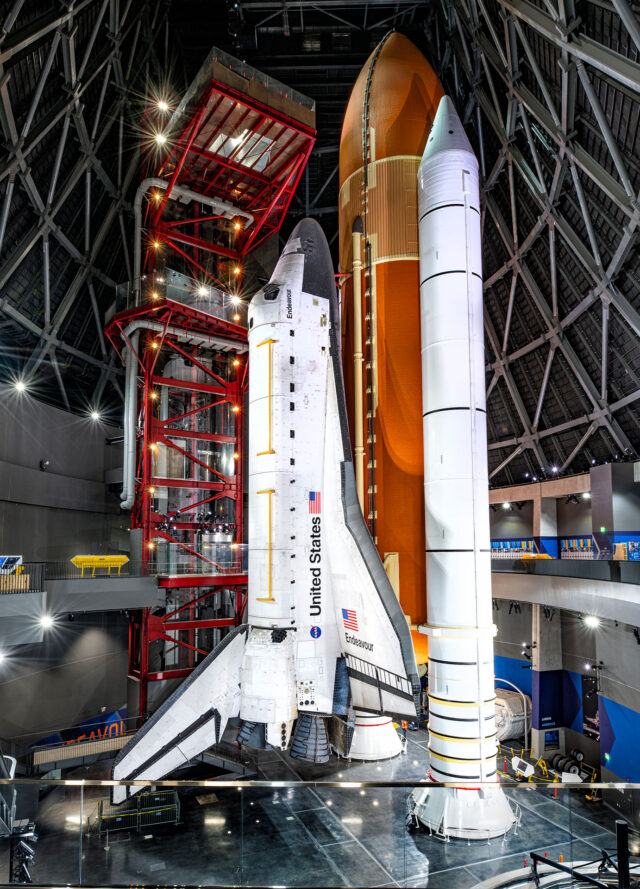
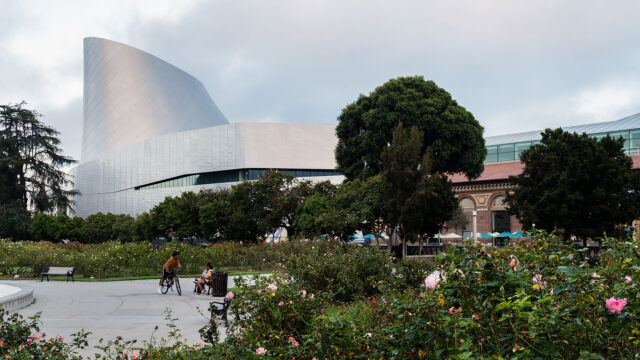
It's not every day that a new one of those sights debuts. But such will be the case on Friday, November 13, when the California Science Center in Los Angeles finally reveals the launch-pad-like display of the space shuttle Endeavor inside the new Samuel Oschin Air and Space Center.

"It has been more than 30 years since we first dreamed of putting a shuttle in the launch position in our air and space center, and it is better than we ever thought it was going to be," said Jeffrey Rudolph, president and CEO of the science center, in an interview with collectSPACE.com. "I haven't had anybody walk in there yet who is disappointed, and more than that, who isn't excited and in awe."

"It is an incredible exhibit and incredible sight," he said.

https://youtu.be/6VbfrOUDdrw

Setting the stage

It has taken four years to construct the new Samuel Oschin Air and Space Center, including accomplishing what many thought impossible: stacking a space shuttle orbiter with its external tank and twin solid rocket boosters without using a NASA facility intended for that purpose.

"I was very uncertain if it would ever happen when we first looked at the proposal, because I think—and the science center admits this—they really had no idea what was involved in trying to make a vertical display of a space shuttle stack," said Dennis Jenkins, a former space shuttle engineer who led the preparation and delivery of the orbiters for their museums before becoming the project director for the Samuel Oschin Air and Space Center.

"We weren't sure that it could be done anywhere other than at a [NASA] specialized facility. Doing it out in the middle of a construction site always seemed a little bit fantastic," Jenkins told collectSPACE. "Of course, it proved to be extremely difficult yet extremely easy all at the same time. Once we figured out how to do it, it worked well."

a full space shuttle stack stands vertical in a new museum indoor display The 184-foot-tall stack, comprising the orbiter <em>Endeavour</em>, external tank, and twin solid rocket boosters, is believed to be the tallest indoor museum exhibit in the world. Credit: California Science Center
Now that the countdown has begun, T-minus 142 days to opening, the pressure is on to be ready to launch. In addition to the Samuel Oschin Shuttle Gallery, the Air and Space Center includes the Korean Air Aviation Gallery and Kent Kresa Space Gallery, which will showcase more than 25 aircraft and both historic and modern spacecraft, respectively.

"We're still installing a lot of exhibits," said Rudolph of the remaining work. "We've got artifacts that are still going in the aviation and space galleries. Quite a few are in, but a lot more are still to go. And we have begun installing the exhibits, but have a lot to install as well."

Over the past year, a segment of a walkthrough space shuttle solid rocket booster has been lifted into the building by crane, a Hawker Siddeley Harrier T.4 aircraft was installed, a Rocket Lab Electron booster was stood up, and in May, the 70-foot forward section of a Korean Air Boeing 747-400 aircraft fuselage was rolled in.

"After that, we'll have a period where we want to do some testing. To study some operational issues before we get open to the public so that it runs smoothly when we do open," he said.

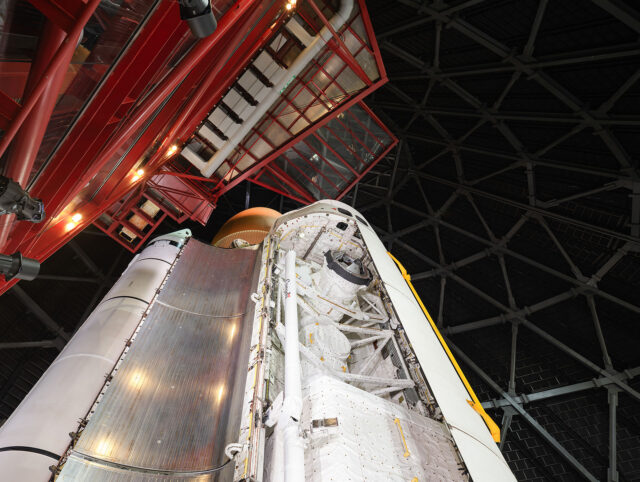
the indoor vertical exhibit of a space shuttle stack includes an open payload bay showing the equipment inside the cargo hold With one of its payload bay doors open, visitors will be able to see the type of equipment used on a mission to the International Space Station. Credit: California Science Center/Mike Kelley
As for Endeavour, it's almost ready for the spotlight. The orbiter is configured so that from one angle, its payload bay doors appear closed, while from another, you can peer through an open door to see the payloads arranged as they would have been for a mission to the International Space Station.

"For the most part, we still have to adjust the lighting in the payload bay," said Jenkins. "Once that gets configured, then we have to latch the closed payload bay door and put a sheet of acrylic over the open crew hatch so that it stays clean inside Endeavour."

A sight to behold

Endeavour has a pre-show before it is revealed on display. (Spoiler warning: Skip the next paragraph if you do not want to know details of the experience.)

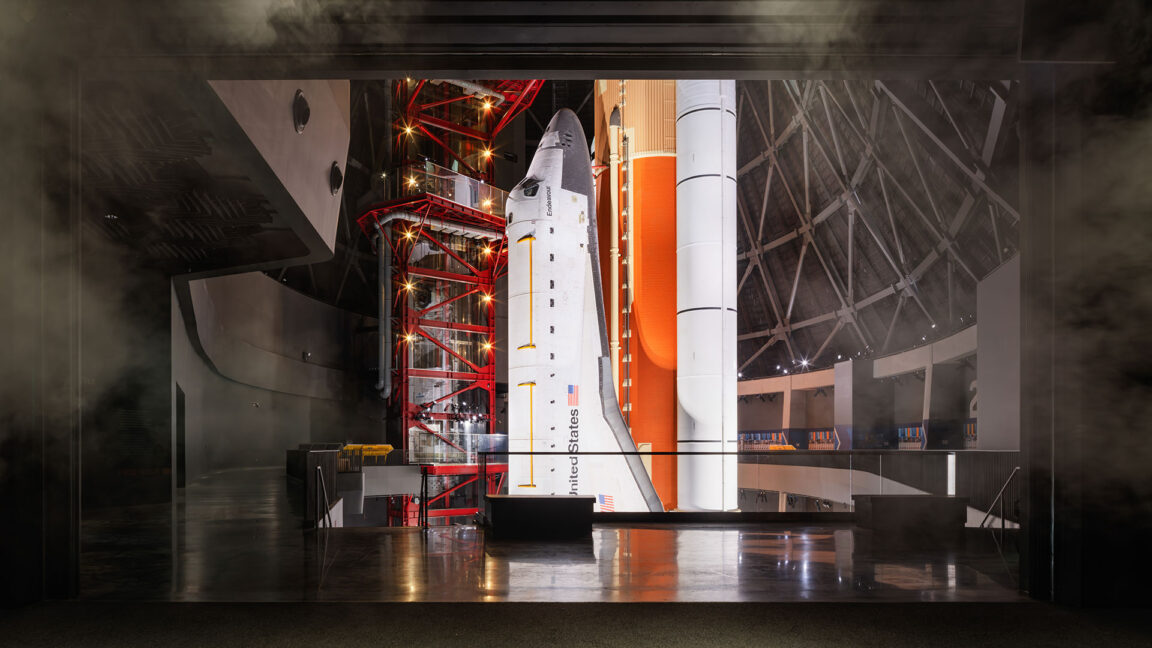
Inside a theater, a video produced by the California Science Center provides a brief history of the space shuttle and how Endeavour came to stand within this building. The footage ends with the final launch of Endeavour as the room fills up with fog. As the air clears, a wall that was once there has dropped away, and you are suddenly just feet away from the 184-foot-tall (56-meter) stack.

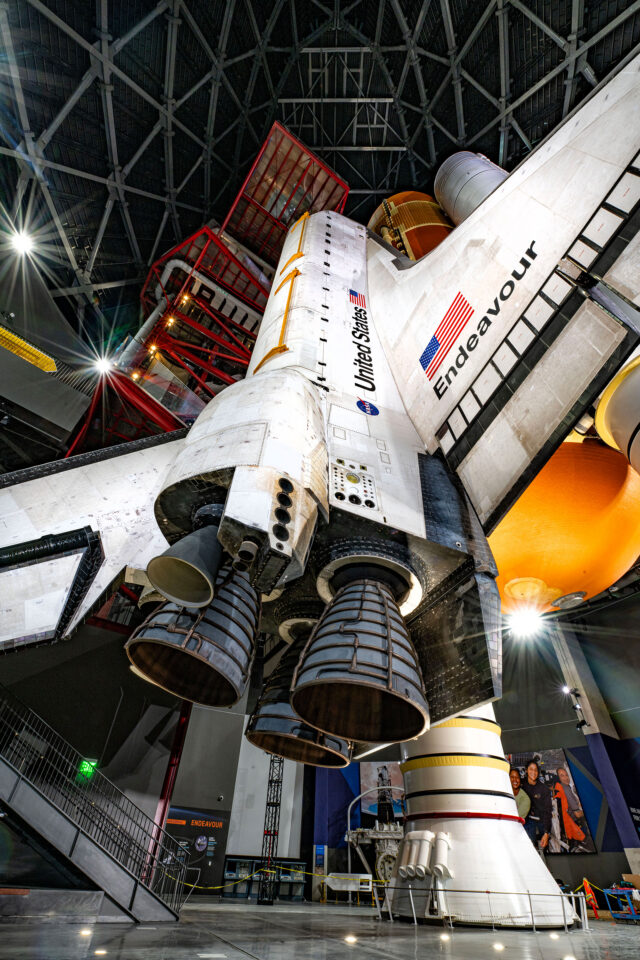
From there, guests will be able to view Endeavour from several levels of the building, from the ground up. There will also be an opportunity for some visitors to board a glass elevator and ascend the gantry standing beside the shuttle. The top level has a transparent walkway, so you can see the entire vehicle below you.

an indoor space shuttle museum display is seen from the floor level looking up The view of space shuttle Endeavour from the ground up. The red gantry tower beside it will offer views from the top down when it opens with the center on Nov. 13, 2026. Credit: California Science Center
"I'm extremely happy that we're almost done and we can show it off because the public has been listening to us for 15 years—30 years, if you go back to the master plan—about how great this is going to be," said Jenkins. "Everybody that has walked into that room just stops, their mouth opens and their eyes open wide, and as often as not, the words "oh shit" come out of their mouths, and you know it's truly one-of-a-kind."

"If you're a space geek, it's unbelievable because the view is like nothing we ever got, even at Kennedy, unless you happen to be on the mobile launch platform as we rolled out," he said. "You never got these kind of views because we always had platforms and other stuff around the vehicle. The views in this place are incredible. They are just amazing."

The California Science Center's new Samuel Oschin Air and Space Center will open on Friday, Nov. 13, 2026. Credit: California Science Center/Mike Kelley
One person particularly looking forward to November 13 is Lynda Oschin, who chose to honor her husband's legacy by directing her family foundation to make the leading donation to the new air and space center.

"It's very exciting. I can't wait to see the expressions and all of the happy tears in the eyes as we saw way back in 2012, when people first walked in and saw Endeavour in in horizontal position. I just can't wait to see all the excitement," said Oschin.

"I did this in the memory and in honor of my husband because the space shuttle incorporates everything that Sam loved and was involved in," she said. "Sam's picture is in the shuttle now and it is always going to be in there. It's in a frame on the flight deck. That really is extra special for me and makes me feel good to know that his picture is in there."

See more photos and video at collectSPACE as the California Science Center continues its first look at space shuttle Endeavour's towering display.

Read full article

Comments


Read the whole story
Share this story
Delete
Next Page of Stories